
Picture this: it was Halloween in Bali. On a Saturday night, no less. My hotel had a perfectly nice pool, the streets of Kuta were gearing up for parties (and a Japanese cosplay convention 😂), and I had absolutely no reason to spend the evening indoors staring at my computer. Plus, I had grand plans for a delicious Indonesian dinner. Naturally, that’s not exactly what ended up happening. 😂
The trouble started at the airport in Makassar, Indonesia with something that should have taken five minutes: installing a travel eSIM on my iPhone. I’ve done this dozens of times around the world with no problem. But this time, the WiFi connection dropped during installation, and suddenly every eSIM on my phone stopped working, including my regular Verizon line. No calls, no texts, no cellular data. Nothing. At first, even the WiFi wouldn’t work.
But, I had a flight to catch. The moment I left Starbucks (and their evil WiFi which dropped and started this) to walk to my gate, it became a very sophisticated camera with a few useful offline features. And with a flight to Australia the following morning, I wasn’t particularly enthusiastic about leaving the problem unresolved.

Remember when we traveled without phones?
Here’s the ridiculous part. I’ve traveled to some pretty remote corners of the world, including plenty of places where infrastructure was limited and getting around required considerable improvisation. And I managed a few of those trips without cellular data to assist: places like Turkmenistan (just last month!), Eritrea, North Korea, Cuba…cell roaming still isn’t a thing there, so I should know how to manage this, right?
Remember paper airline tickets? Folding maps? Guidebooks? Asking hotel receptionists to call taxis? Hunting for internet cafés to check email? I’m not suggesting those were the good old days of travel. Getting lost wasn’t always charming, and changing an airline reservation from the middle of nowhere at the last minute was rarely an option without massive hassle.
But somewhere along the way, I feel like I’ve gone from using phones to make travel easier to building much of my travel experience around the assumption that they’ll always work.
The troubleshooting rabbit hole
I did what any reasonably tech-savvy traveler would do: started troubleshooting. I also enlisted ChatGPT, which quickly produced an impressive collection of possible explanations and recovery procedures. Since AI and travel is a fairly hot topic lately, I wanted to go into this just a bit.
To be fair, AI was genuinely a bit useful. It gave me information and options much faster than I could have researched them myself. But it also demonstrated something AI still struggles with: good human judgment.
One attempted fix led to another. Network resets, software updates, firmware downloads, connecting the phone to my MacBook, conversations with Verizon, and increasingly elaborate recovery procedures. At one point, I was downloading roughly 14 gigabytes of software over hotel Wi-Fi that was slower than a snail. Every unsuccessful attempt seemed to produce another plausible suggestion.
What ChatGPT wasn’t good at recognizing was that I had a finite amount of time in Bali, and each additional attempt was consuming more of it. Sometimes the most useful advice isn’t another technical solution. It’s simply, “You’ve tried most of the easy fixes. Go have dinner and a beer.”
Eventually, I got Apple support to run remote diagnostics twice and it reported a “failed eSIM presence check”, suggesting a hardware problem they thought. I tried to tell them hardware failing at the exact moment I tried an eSIM install was quite unlikely, but they insisted there was nothing more they could do. By then, my Saturday in Bali was essentially gone.
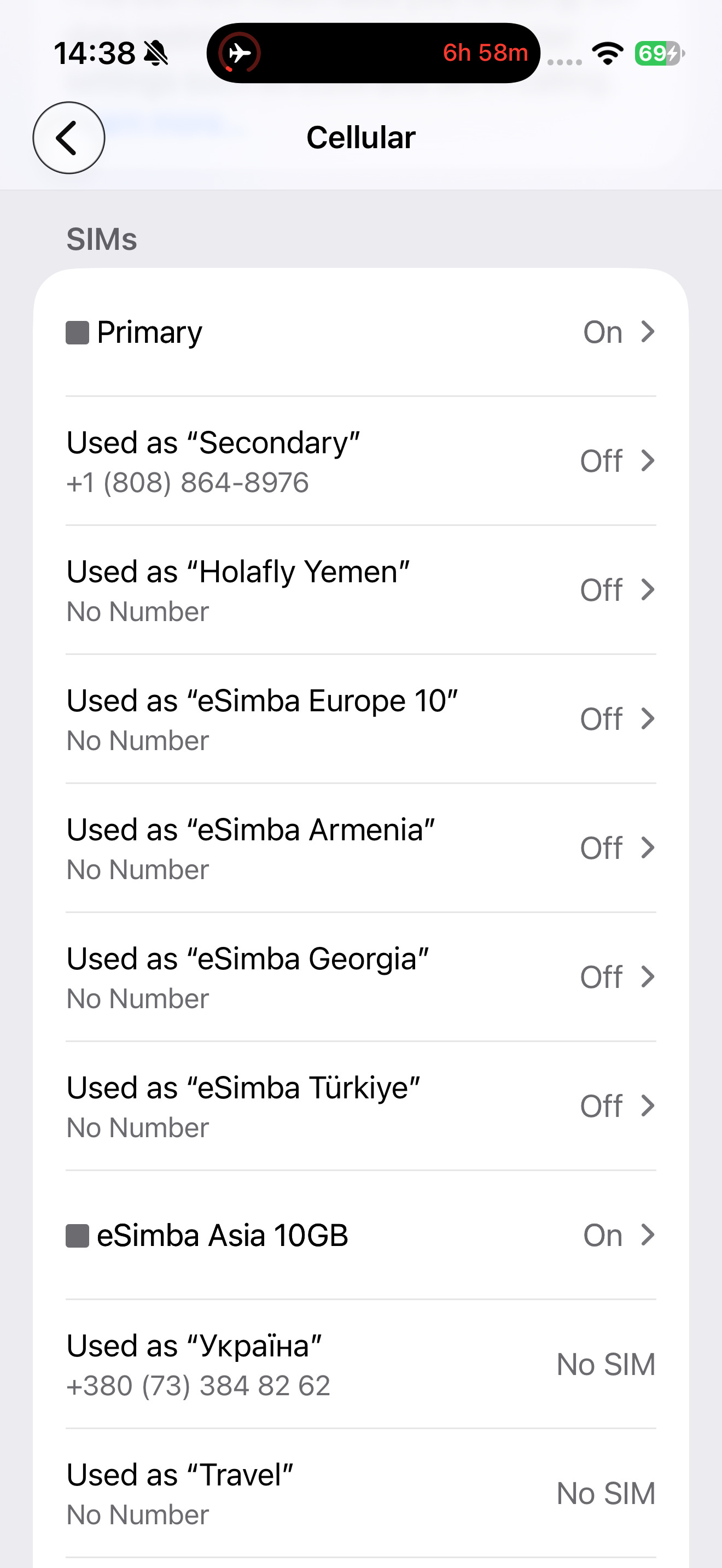
Australia, here I come. Without mobile data.
The next morning I flew my scheduled flight to Perth, beginning several days of travel around Western Australia. Suddenly, I was planning my movements around wherever I could find Wi-Fi.
Before leaving a hotel or airport, I made sure I’d downloaded the maps I needed. Fortunately, offline navigation worked pretty well. Boarding passes weren’t a problem either. I could check in while connected and save everything I needed.
Uber and taxis, however, were a totally different story.
Think about how ride-sharing apps work. You order a car, watch the little vehicle icon approach, and receive updates about the driver’s arrival. It’s wonderfully convenient. Unless you lose your internet connection the moment you walk outside.
I could summon an Uber while connected to Wi-Fi, then step onto the street and immediately lose the ability to track it. Was the driver two minutes away? Had the car arrived? Was it parked around the corner? Had the driver canceled?
No idea. I was essentially back to standing on a street corner hoping the right car would eventually appear. 😂 Some of the towns I went to were much smaller, and didn’t have Uber/etc. I had to call a taxi the old-fashioned way. Except…I no longer had a phone, I had an expensive paperweight. I couldn’t call anyone.
At least the camera still worked. In Kalgoorlie, I managed to photograph Questa Casa, which advertises itself as Australia’s oldest historical brothel. Not exactly the attraction you’d expect to find in a conventional tourism brochure, but certainly an interesting piece of local history. Thanks to NomadMania for the idea.

Meanwhile, getting the phone fixed proved nearly as frustrating as breaking it. During a Perth layover, I tried walking into an Apple Store, only to be told the wait without an appointment could be two to three hours. Four days later, at the Genius Bar with an appointment, I learned that Australian and American iPhone models differ, so replacing it wasn’t possible. Their advice was to try a full restore, then pursue repair or replacement back in the US if necessary.
We’ve made travel easier. And more fragile.
I’m not a luddite. I love what technology has done for travel. Google Maps alone has probably saved me hundreds of hours of wandering around unfamiliar cities. Add electronic boarding passes, translation apps, mobile banking, ApplePay, restaurant reviews, and ride-hailing, and independent travel has become dramatically easier.
But we’ve also put an extraordinary number of eggs in one very small basket.
Our phones are now our maps, taxi dispatchers, translators, cameras, boarding passes, banking terminals, and communication devices. And increasingly, they’re how we prove our identities. It’s an incredible amount of convenience packed into something that fits in your pocket.
I’m certainly not advocating a return to paper tickets, travelers checks, and folding maps. But downloading maps in advance, keeping important travel information available offline, and knowing how you’ll manage transportation without mobile data suddenly seem like pretty sensible habits.
And perhaps there’s another lesson from my lost Saturday in Bali: sometimes the time we spend trying to solve an inconvenience becomes more costly than the inconvenience itself.

I’ve traveled to some pretty remote corners of the world without cellular service, and I managed to get around Western Australia without it in 2026. It wasn’t always convenient, but it wasn’t exactly unfamiliar territory either. Data roaming still isn’t an option in places like Turkmenistan, North Korea, and Eritrea. The difference is that when I visit those countries, I know what I’m getting into and plan accordingly. This time, I hadn’t.
With AI becoming the answer to seemingly every travel question for some travelers, I do wonder how some of us would manage if both our phones AND our favorite AI assistants suddenly went offline. Would we still know where to go, what to see, or even how long to stay? Five minutes? Thirty? 😂
And maybe that’s the real lesson. Our phones are supposed to support our travels, not become something our travels depend entirely upon. Technology has made exploring the world easier than ever, but a little preparation, flexibility, and old-fashioned improvisation still go a long way.
Now, if someone could just tell me where my Uber is... 😂