
Over the past few weeks, I’ve been writing a lot about risk. Not eliminating it (because that’s not possible) but understanding it, managing it, and deciding which risks are actually worth taking. Travel has a way of forcing those decisions on you, often in moments where you don’t have the luxury of time or perfect information. Most of the time, things work out smoothly. But every so often, you find yourself in a situation where the plan just starts to fall apart and what happens next depends less on logistics and more on judgment.
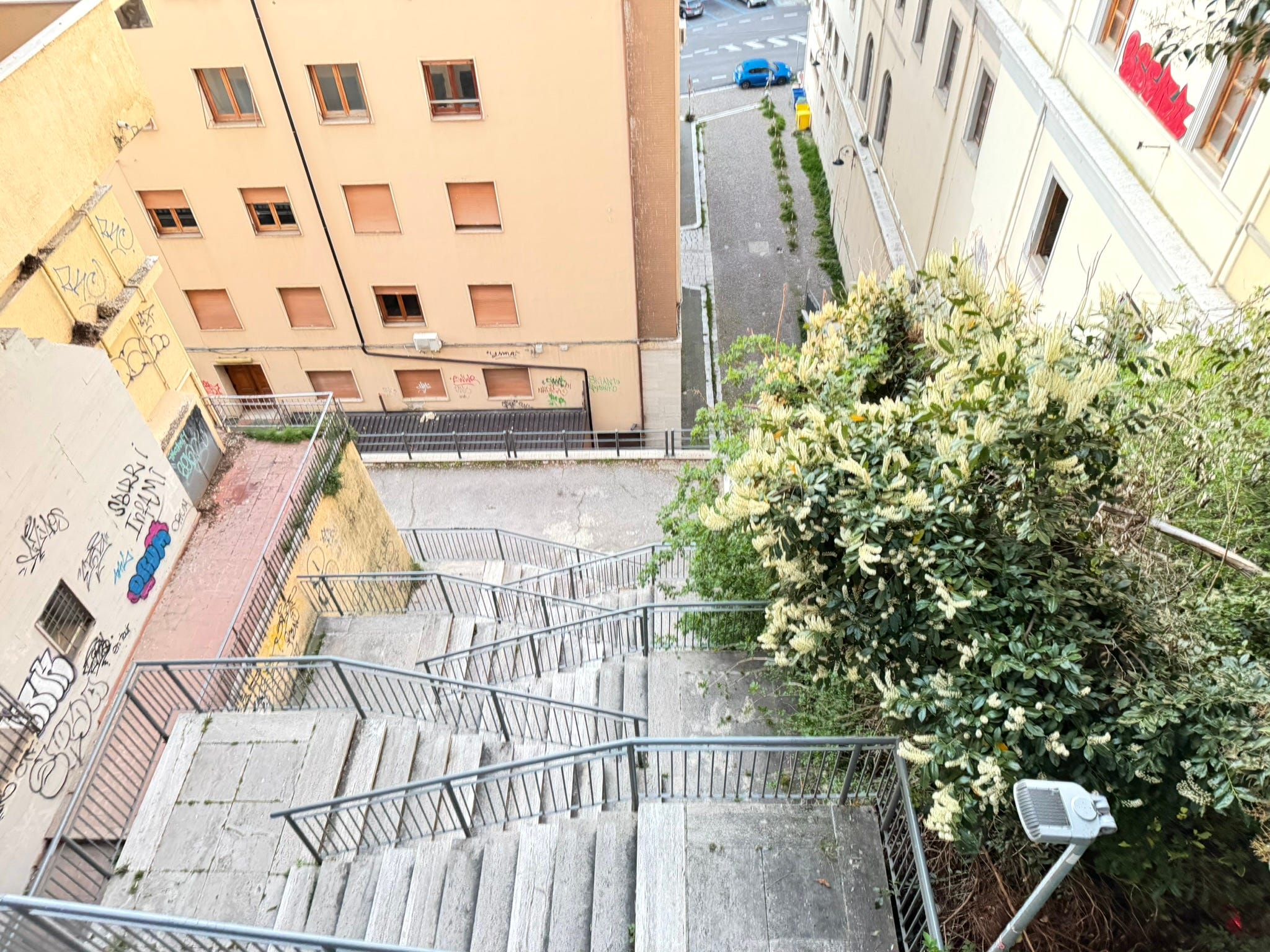
For me, one of those moments came recently in Potenza, Italy. It’s a place that feels remote even by Italian standards, perched high in the mountains as the country’s highest regional capital. Getting there requires more than a little bit of time and planning. There’s currently no train service, so you take a bus from Naples or Foggia, and even then you’re not quite finished. From the bus stop, you can take a taxi (which I couldn’t find) or a small shuttle train that climbs toward the town. And once you arrive there, there are still several hundred steps and staircases to reach the old town itself. It’s not that difficult, but it’s enough to remind you that you are not in a place built for convenience or mass tourism.
The more interesting part of the story, though, was not the journey in. It was trying to escape the next morning.
I had an early start…one of those oh-dark-thirty departures that feels closer to the middle of the night than the beginning of the day. I made my way down to the shuttle train station, which, in fairness, was considerably easier going downhill than it had been the day before. The station was quiet. I checked the schedule I had photographed the previous day and waited.
And waited.
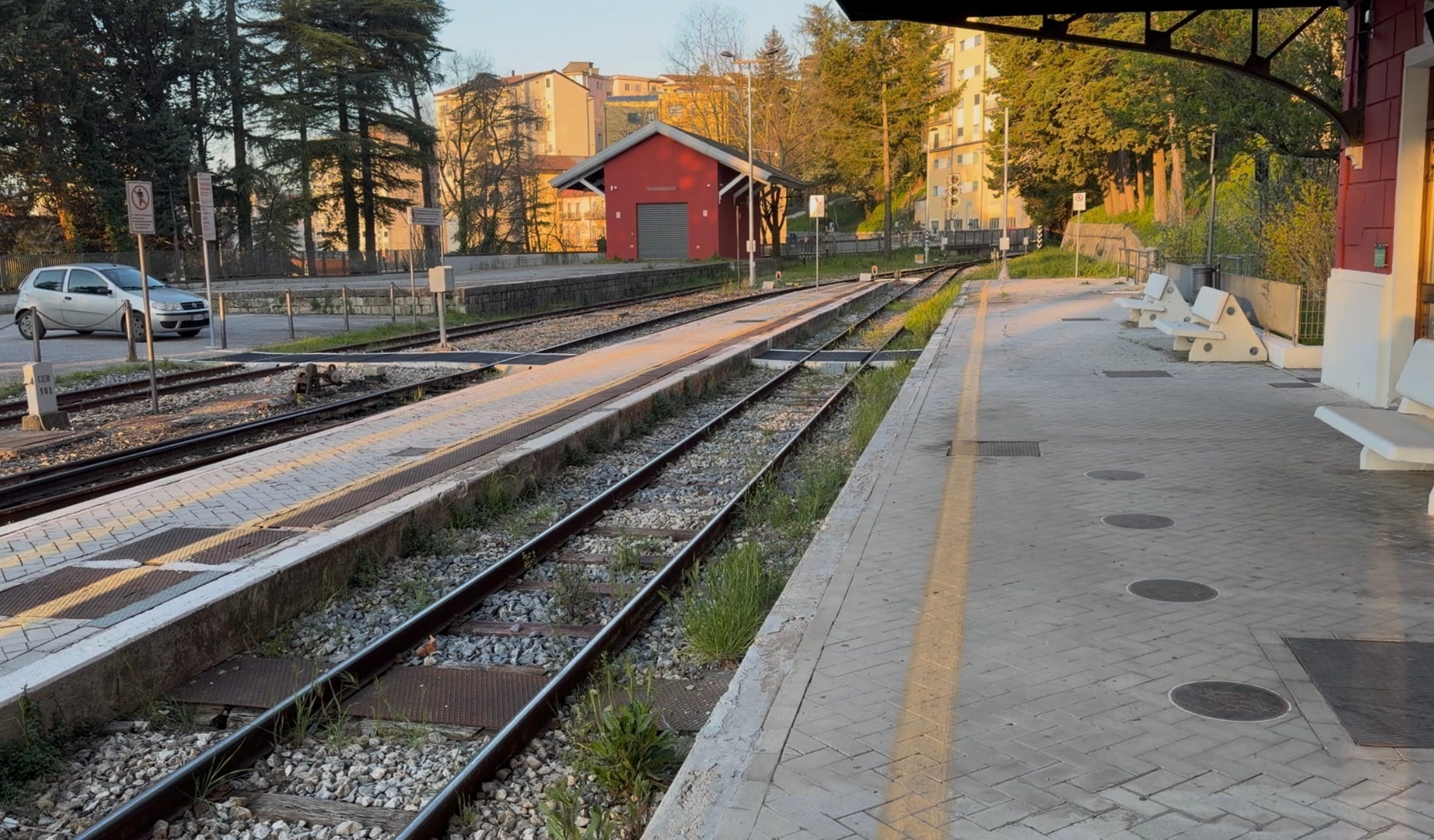
Ten minutes passed beyond the scheduled time, then fifteen. I started to worry about my connecting bus which was leaving soon. At first, it felt like a minor delay, the kind that happens everywhere. But as the minutes ticket on by mild panic started to settle in. Connections depend on timing, and timing, in this case, was not on my side .
At that point, a man approached me and asked, in Italian, what I was doing there. Now, I don’t speak Italian beyond maybe 100 words, but Potenza is one of those places where you still don’t find much English, but with my 100 words and google translate I managed to explain that I was waiting for the overdue train. I showed him the schedule on my phone.
He looked at it, confused…paused, and then pointed to a sign on the wall nearby.
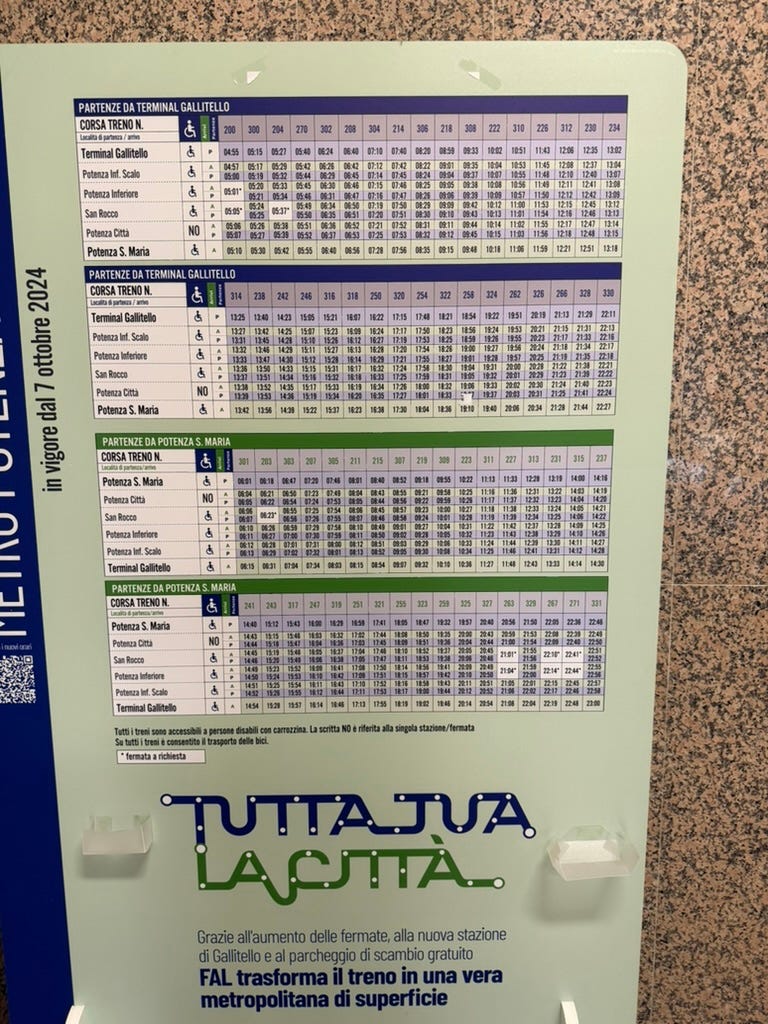
The schedule I had taken a pic of and which was prominently posted on the wall was from 2024. The current one…the one that mattered…was different and posted on another wall I never saw. The train I was waiting for was not coming.
With only a few minutes left before my onward connection, the situation had moved from inconvenient to missing my bus and the next region I planned to visit. I explained as best I could that I needed to be at the bus stop quickly. There may have been some wild Italian-style gesturing…there was no hesitation in his response. He simply gave me that “come with me” gesture and started speed walking.
This is the point in the story where instinct takes over.
We are taught, quite reasonably, not to trust strangers. That instinct serves an important purpose, and ignoring it entirely would be naïve. But travel also introduces moments where rigidly applying that rule doesn’t quite fit the reality in front of you. The decision becomes less about rules and more about reading the situation: tone of voice, body language, urgency, context.
There was nothing theatrical about the moment (well, nothing more than is that “passion” that Italy does so well. No attempt to persuade, no ambiguity in intent. It was direct, practical, and immediate. It felt like help.
So I followed.
He led me to his car, parked a short distance away, and we set off. What followed was a drive that can best be described as efficient in the way that only Italian driving can be: fast, controlled, and entirely focused on the task at hand. Within minutes, we arrived at the bus stop, just as my connection was about to depart.
There was no ceremony to the end of it. A brief exchange, a quick and heartfelt grazie mille, a nod of acknowledgment, and he was gone.
The entire interaction lasted perhaps six or seven minutes. Its impact on me will last much longer. He made a difference.
“Look for the Helpers”
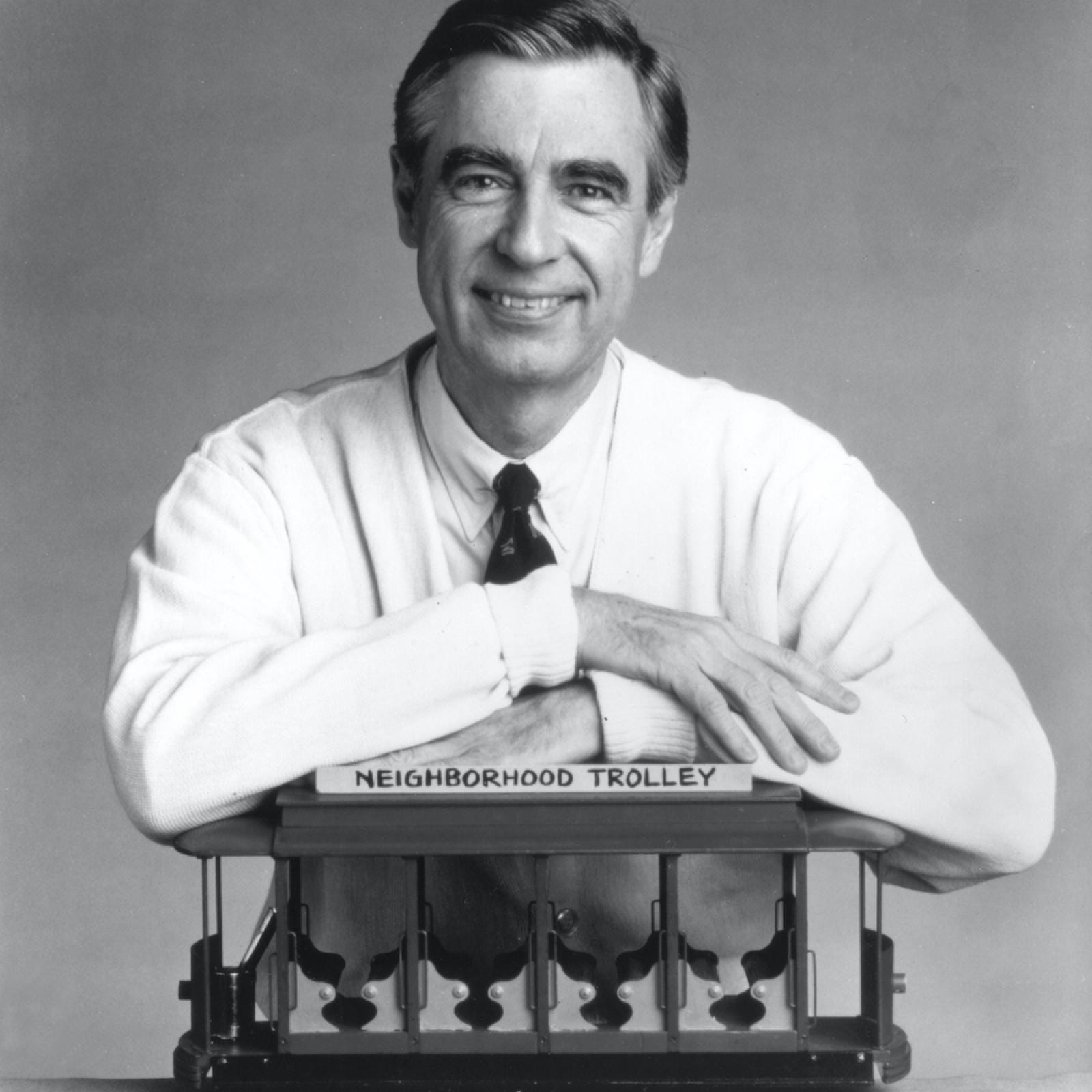
The phrase “look for the helpers” comes from Fred Rogers, who shared a piece of advice his mother gave him when he was a child. Whenever he saw something frightening in the news, she would tell him to look for the people who were helping. The idea was simple: even in difficult or uncertain situations, there are always individuals who step forward to make things better.
It is an idea that can feel almost overly saccharine and sentimental in the abstract. But in practice, it is something most experienced travelers recognize immediately.
Because if you have traveled enough, you have your own version of this story. The stranger who offered directions when you were lost. The driver who went out of their way to make sure you arrived safely. The person who noticed something was wrong and intervened without being asked. These moments are rarely dramatic, but they are often decisive.
At the same time, travel also teaches the opposite lesson. There are moments when trust is misplaced, when someone takes advantage of uncertainty or inexperience. Those stories exist as well, and they are part of the same reality. The challenge, then, is not to choose between trust and skepticism, but to find a balance between the two.
There is no precise formula for doing this. Experience helps. Awareness helps. Over time, you become better at interpreting the signals that surround a situation. You learn to recognize when something feels off, and just as importantly, when it doesn’t. Instinct, in this sense, is not blind; it is informed by everything you have seen and learned along the way.
The goal is not to move through the world assuming the best of everyone, nor is it to assume the worst. It is to remain open enough to accept help when it is genuinely offered, while staying aware enough to recognize when it is not.
That morning in Potenza was not extraordinary in the grand scheme of life or travel. It did not involve danger or dramatic stakes. Missing a region to visit wouldn’t be the end of the world. But it served as a reminder of something easy to overlook, particularly in this day and age when it often feels as though division and distrust dominate the narrative.
On the ground, in real places, among real people, the story is almost always more nuanced. There are risks, certainly. There are those who wish to divide us, absolutely. But there are also many people who, without hesitation, choose to help.
And if you pay attention, you will find them.
Over to You
What is your “helper” story? When has a stranger stepped in and changed the course of your trip?
And just as importantly, when have you trusted your instincts and decided not to?
These are the moments that shape how we travel and how we understand the world around us.
I love this. Those interactions are the best part of travel. Good stuff.